Mark Emdin
September 2025
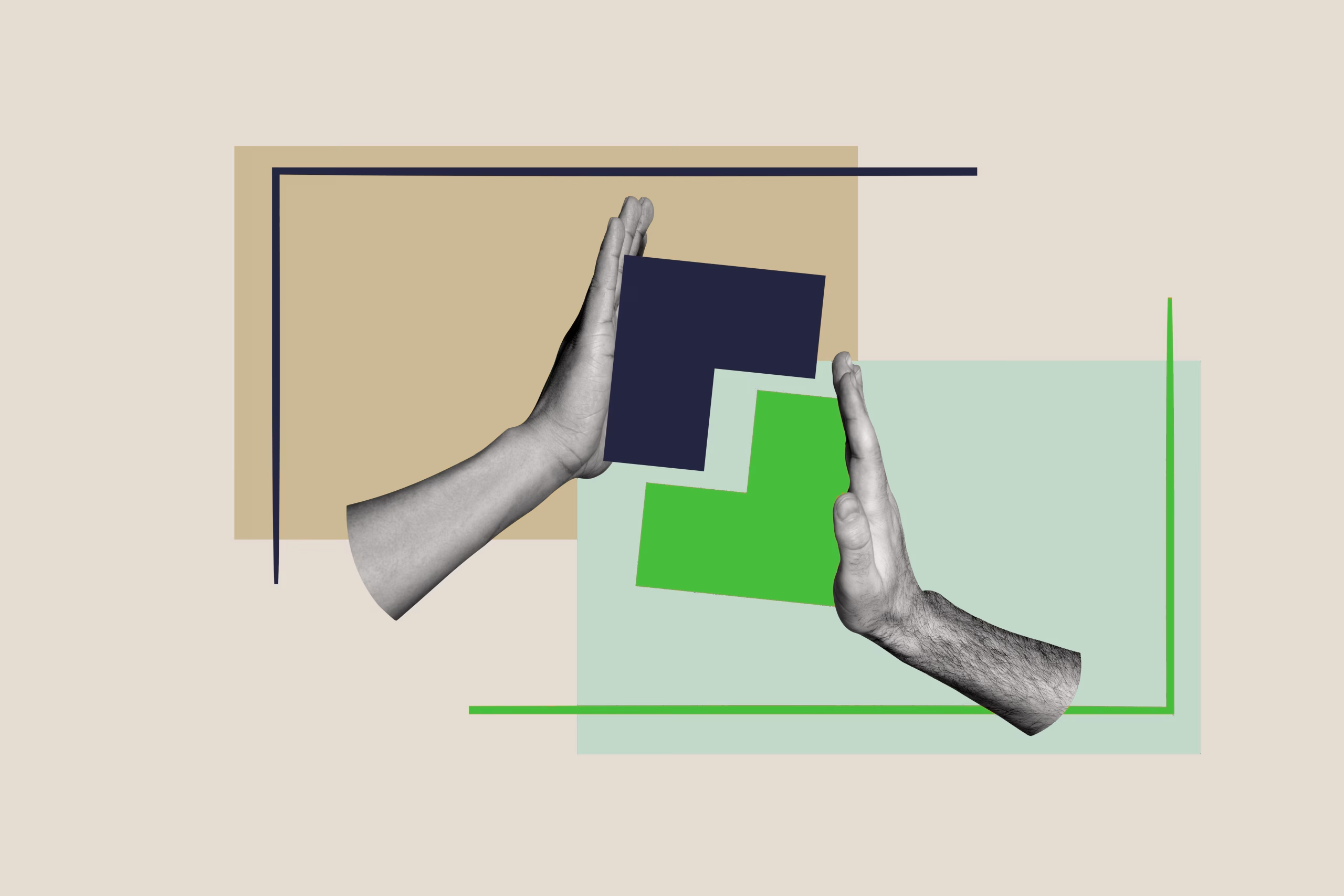
Organisations don’t succeed on strategy, structure or culture alone. They perform when design (operating model, roles, decision rights, workflows) and dynamics (psychological safety, norms, relationships, ways of working) reinforce each other. Treat them as a pair, and transformation sticks. Treat them separately, and improvement stalls.
It is within this dynamic interaction that we at Ammalo focus our efforts, collaborating closely with our clients.
What do we mean by “design” and “dynamics”?
Design: how work and activities are partitioned and coordinated, operating model choices, role clarity, accountability, decision architecture, and core routines.
Dynamics: how people actually interact, trust, safety to speak up, learning behaviours, collaboration, conflict competence, and leadership signals.
Neither side is “soft” or “hard”, they’re interdependent. This interdependence has deep roots in socio-technical research showing that technical structures and social systems must be jointly optimised for performance.[i]
Vignette – A Team Being Too Nice to Each Other
A global technology team faced complex structures, unclear roles, and siloed operations that hampered coordination and effective delivery. They set out to review their organisational design to clarify accountabilities and better support the wider business.
As the team explored new operating models, it became clear that their own behaviour, being too accommodating, avoiding tough conversations, and resisting bold decisions, was holding back true progress. Addressing these dynamics required real-time courageous leadership.
Once the team named these challenges, they began to shift behaviours, supporting each other and developing a future-focused model that addressed long-standing issues.
Our Work is Evidence Based
At Ammalo, our work is grounded in robust, peer‑reviewed research. We believe that lasting organisational change comes from approaches proven to work, not untested opinion. This evidence base guides every engagement, shaping how we diagnose challenges, design solutions, and measure impact.
For example, Andrew Campbell and Michael Goold’s[ii] work on organisation design emphasises the alignment between structure and strategy, while recognising that the health of the organisation depends equally on how people work within those structures. Their research underlines that clarity of purpose, decision rights, and accountability frameworks need to be paired with trust, collaboration, and shared norms to create sustainable performance. This echoes findings from Edmondson[iii] on psychological safety, Tubre & Collins [iv]on role clarity, and others, highlighting that effective design enables the very dynamics that drive adaptability and results.
Five design moves that reliably shift dynamics
In our work, we generally find that organisations want to lead with design as a way of responding to organisational changes. There can be pitfalls in pulling the structure lever (lines and boxes) too quickly without taking into consideration other design moves. Below we share moves that consider both design and dynamics, recognising that lasting change comes from shifting structures and activating the behaviours you want to see from the outset.
- Make decision rights visible (and narrow the shadow hierarchy). Map who ‘recommends’, who must ‘agree’, who ’decides’, who ‘inputs’, and who ‘performs’ (RAPID)[v]. Clear decision roles minimise ambiguity, reduce turf wars, speed recovery from errors, and lower interpersonal risk in meetings by making both accountability and collaboration explicit.
- Tighten role clarity; loosen control over methods. Specify outcomes, what and why of work, interfaces, and accountabilities; give teams autonomy on how. This combination strengthens ownership (design) while encouraging learning behaviours, innovation, and adaptability (dynamics)
- Design for candid dialogue. Put “speaking up” into the operating rhythm—e.g., decision pre-reads with named risks, after-action reviews, and leader check-ins that normalise uncertainty. These structures set the conditions for honest discussion while fostering the interpersonal trust needed to have it.
- Shape team boundaries and handoffs. Define who is “on the team,” the team’s unique work, and its interdependencies. Clear boundaries reduce confusion and blame (design) and help trust and collaboration build around shared responsibilities (dynamics).
- Lean into future-focused behaviours. As you design roles, structures, and processes, intentionally model and encourage the behaviours and dynamics you want to see in the future organisation. Don’t wait until the design is “finished”—bring those ways of working to life during the design process so they are embedded from day one.
In bringing these elements together, the aim is not simply to rearrange structures or adjust behaviours in isolation, but to create a self-reinforcing system where design choices naturally foster the dynamics that enable teams and organisations to thrive. This integrated approach helps leaders move beyond temporary fixes, embedding long‑term resilience, adaptability, and performance into the fabric of the organisation.
Questions to explore in your context
Where do people experience the greatest role ambiguity today? What decision type generates the most churn?
Which meetings already show genuine learning behaviours, and what design features (materials, roles, timeboxes) enable that?
If you needed to reconfigure a team in 30 days, which design constraints would slow you down? How could you modularise now to increase adaptability?